
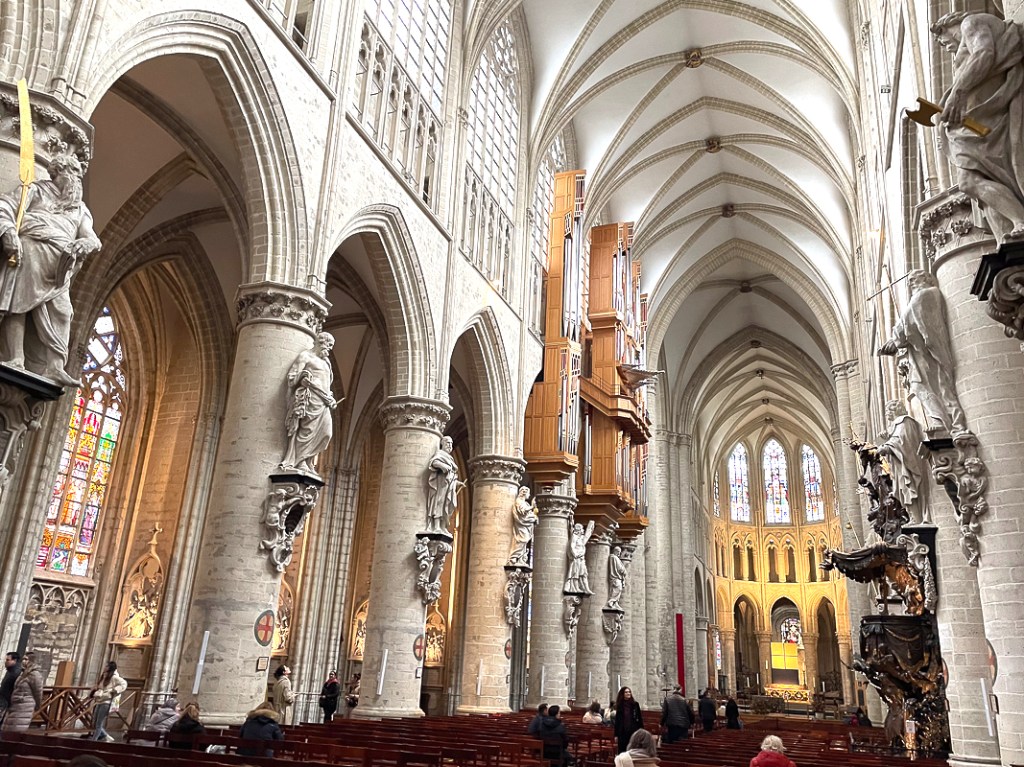
When my son was in high school, the wife of one of his baseball coaches passed away in her thirties, leaving her husband with four young children. The Catholic funeral was packed with people, literally standing room only. The Mass was beautiful, moving, and also heartbreaking. And I had an important revelation.
Even though I attended a Methodist church with my family when growing up, I have not belonged to any church since graduating high school. And I didn’t raise my children in a church either; however, I did send them both to religious schools. I felt like the education provided was better than the local alternative, and I appreciated the focus on character and values. But that didn’t mean I raised them in a religious household.
But sitting through that funeral, it became very clear to me just how important organized religion and the corresponding community is during difficult times, times like a funeral. It isn’t as if I did not know that intellectually, of course, but it was explicitly evident on that heart-wrenching day. I have also seen the benefits of church for weddings, during times of sickness and for families with new babies.
The church was important to my mother. She was very involved in our family church for decades: she had close friends there, volunteered extensively, hosted church events at our house, and belonged to numerous committees and clubs. But by the time she died, she had been ill for years and as a result hadn’t been to church in a while.
It was difficult to attend her funeral at that church when the current minister didn’t know who my mom was. Throughout the service, the minister repeatedly said, “People have told me that she was [fill in the blank].” The whole thing depressed me, especially since she had been so involved in that church. It was so disconnected from who she was.
Last year, nearly ten years after my mom passed away, her best friend from our years living in Chicago when I was in elementary school died. They had kept in touch for a long time, and I was close friends growing up with her daughter, who was my age. I now live in Chicago, so I made sure to attend her funeral. Their family was very Catholic, but the funeral was at a presbyterian church. That was curious. But I learned that she was a member of that church for many years – I have no idea what happened with her and the Catholic church.
The church was full, and the minister was young. But he knew her. And he told personal stories about his experiences with her. He told funny stories, inspiring stories, and stories of love. And it was all heartfelt. He drew the picture of the full life of a woman I hadn’t seen in probably 40 years. She was clearly a woman he not only knew personally but loved.
I have joked with my kids that I want a New Orleans style funeral, with a somber march to the church and a celebration parade leaving, complete with umbrellas and a jazz band. I am not really serious, but it sure sounds like a powerful way to say goodbye!
But after attending the funeral with my teen-aged son, I told him what I really want for my funeral.
I want my children to plan whatever they think will most help them get through. Usually, children feel obligated to follow their parents’ wishes when it comes to any funerals or memorials. My goal is to have no “wishes,” is to let my children follow their own wishes as to how to best say goodbye. And even though I wasn’t religious, if having a religious funeral for me gives them comfort, then they should do it. Because there is obviously huge value in the closure awarded by the tradition and ritual of a religious funeral. It may even be worth belonging to a church simply for that.
Last weekend I attended a mass at a Roman Catholic church here in Chicago, not because I have “found” religion but for a project I’m working on (to be revealed at a later date). The homily was powerful.
The priest mentioned that he had presided over a few funerals in the last couple of weeks. He added that he is seeing something in popular culture that he really doesn’t like. For example, last week he buried a 53-year-old woman. Her children wanted to only do a quick ceremony with a few prayers at the cemetery.
The priest was concerned about this, about not having a funeral Mass. He sees more and more that young people put their own agenda on their parents. And in a case such as this, they aren’t letting their mom fulfill her faith.
The children decided on a compromise. They would hold a funeral Mass but not a wake. And they were shocked when over 150 people showed up at the Mass. They were overcome by the impact that their mom had on the living and on the community. They had the opportunity to see their mom through different eyes.
“There is an awful lot of life in the gathering,” the priest pointed out. “But,” he added, “what if they had held a wake?”
If they had, he concluded, those children would have experienced the resurrection of their mother.
He had my attention. I have never heard a preacher use the Bible and the story of Jesus’s resurrection to discuss how it might be possible for us to also be resurrected.
What happens at a wake? It is typically a Catholic practice and is a gathering held before the funeral. It is fairly relaxed, and often includes food or drink, family and friends. The body of the deceased is also present, giving people the opportunity to personally pay their last respects.
If they had held a wake, the children would have heard people tell stories about their mother that they had never heard before. Some of those stories would have come from people who they had never met before, from people who knew their mother long before the children were born. They would learn many new things about the person they called Mom. They would be introduced to sides of their mom they had never met.
I remember having a similar experience at a wake I attended. The man who passed was not one of my favorite people. I had only known him for the last 15 of the 80 years he lived. And my experience with him was of a cranky, drunk, obnoxious old man. But at the wake, I heard stories of times when he was younger. Of times when he won awards and acclaim from organizations and from work. Of times when he was the life of the party and on everyone’s list to include who wanted to enjoy a good time.
As the priest said, when you hear these stories, the person rises in your vision. They are, shall we say, resurrected.
Amid the suffering and tears, people can smile at the impact the person had on this world. When you leave a wake, you have a new sense of what it meant for that person to have been alive.
The priest ended his homily with a story about the death of his own mother at 97 years old. She had only completed one year of high school and lived a simple life. It was easy for him to assume that she had very little impact on the world. Plus, all of her friends had preceded her in death. But as it turned out, his mother’s wake was crowded with people. The priest learned that his mother’s impact on the world and on people was significant, and it reached far beyond what he could have imagined.
And what did he see among the stories and the laughter and the tears? Among the friends and the strangers? He saw the resurrection of his mother.
 The Writing Life
Your thoughtful post on funerals and rebirth has sparked a deep interest in me. The concept of allowing children to decide on the funeral arrangements to best suit their grieving process is both touching and thought-provoking. Do you think this flexibility in adhering to or deviating from traditional funeral practices could influence the way future generations approach the concept of mourning and remembrance?
LikeLike